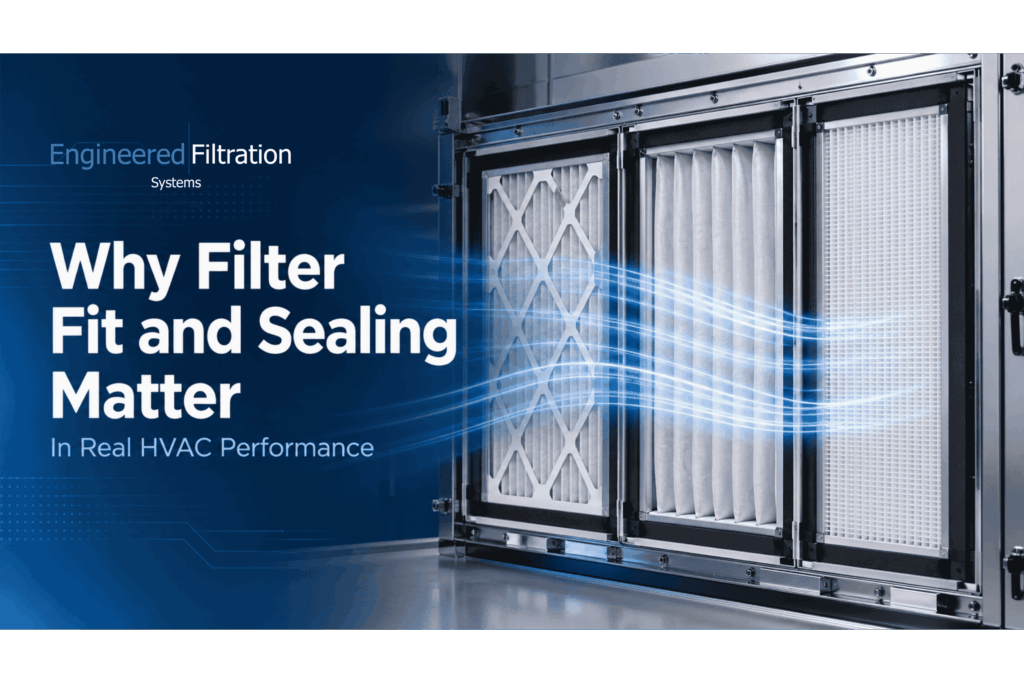
When people compare air filters, the conversation usually starts with efficiency ratings. MERV ratings matter, but they are not the whole story. In real HVAC applications, a high-efficiency filter can only perform as intended when air is forced through the media instead of slipping around it. ASHRAE says filters must be sealed well to deliver expected performance, and EPA guidance similarly stresses snug fit and minimum-leakage filter assemblies to prevent air from bypassing the filter bank.
That is why filter fit and sealing in HVAC systems deserve just as much attention as the filter’s published rating. If the rack is damaged, the access door does not seal, the gasket is missing, or the filter does not fit tightly in the frame, the system may move contaminated air around the filter instead of through it. On paper, the filter may look like the right choice. In the field, the actual performance can be something very different.
The problem with focusing only on MERV
A MERV rating tells you how a filter performs under standardized test conditions, but HVAC performance in an operating building depends on more than the media alone. ASHRAE notes that overall effectiveness depends on filter efficiency, airflow rate through the filter, particle size, and the filter’s location in the HVAC system or room air cleaner. That means filter performance is always tied to the way the full system is designed, installed, and operated.
ASHRAE also warns that increasing filter efficiency generally increases pressure drop. If the system is not designed to handle that added resistance, the result can be reduced airflow, higher fan energy use, or both. In other words, a filter upgrade has to be evaluated as a system decision, not just a product decision.
What bypass really means
Filter bypass happens when air finds an easier path around the filter instead of through the filter media. This can happen because of undersized filters, bent frames, damaged holding systems, poor gasketing, worn access doors, or gaps between the rack and the housing. EPA’s design guidance for HVAC systems specifically recommends air filter assemblies designed for minimum leakage, with gaskets and sealants at points where air could bypass the filters, including between the filter rack and the access door.
This is one of the most overlooked reasons real-world filtration performance falls short of expectations. Even a well-rated filter cannot capture particles that never pass through it. ASHRAE puts it plainly: the airflow has to pass through the filter and not around it due to leaks.
Why filter fit and sealing in HVAC systems matter so much
1. They protect actual filtration performance
A filter only works when the airstream goes through the media. If gaps or leakage paths allow bypass, the system may deliver lower air-cleaning performance than the specified filter rating would suggest. Both EPA and ASHRAE emphasize proper sealing and snug fit for that reason.
2. They help maintain system efficiency
Poorly fitted filters can create uneven loading, leakage, and unstable system behavior. EPA’s school HVAC guidance recommends differential pressure monitoring across filter banks and minimum-leakage assemblies, which reflects the importance of both system condition and ongoing performance verification.
3. They support better use of higher-efficiency filters
ASHRAE recommends MERV 13, with MERV 14 or better preferred, when the system can accommodate it. But ASHRAE also says the HVAC system’s capabilities have to be considered, because higher-efficiency filters usually increase pressure drop. A proper seal becomes even more important when facilities invest in better filters and expect better results.
4. They reduce the gap between specified and delivered performance
It is easy to assume that buying a better filter automatically produces better indoor air quality. In reality, the rack, housing, door seal, spacers, and fit condition all influence whether the rated filter performance is actually delivered in the field. EPA’s guidance on filter sizing also says the filter should fit snugly without being bent or crushed to make it fit.
Common causes of poor fit and sealing
In commercial and industrial systems, poor sealing usually comes from a few repeat issues:
- damaged or out-of-square filter racks
- missing or worn gaskets
- loose access doors
- improperly sized replacement filters
- poor retention hardware or missing spacers
- field conditions that allow leakage around the bank rather than through it
EPA’s HVAC design tools specifically call out gaskets, sealants, gasketed spacers, and proper rack design as part of a minimum-leakage filter assembly.
What buyers and facility teams should check
When evaluating filter fit and sealing in HVAC systems, the right question is not only “What MERV rating are we buying?” It is also:
- Does the filter fit the frame correctly?
- Is the rack square and structurally sound?
- Are the access doors sealing tightly?
- Are gaskets, clips, and spacers in good condition?
- Is there visible evidence of bypass or dirt tracking around the frame?
- Can the HVAC system handle the selected filter without unacceptable airflow loss?
ASHRAE’s filtration guidance supports this system-level view by emphasizing sealing, airflow through the media, and the system’s ability to accommodate higher-efficiency filters without harming performance.
Why this matters for manufacturers and end users
For manufacturers, this topic is important because filtration performance is often judged by field results, not just lab ratings. For end users, it matters because buying a premium filter does not guarantee premium performance if the installation environment is compromised. A strong filtration strategy combines the right media, the right construction, the right fit, and the right system conditions. EPA and ASHRAE guidance both point in that direction: good filtration requires both appropriate filter selection and an assembly that minimizes leakage.
The EFS perspective
At Engineered Filtration Systems, we know that filter performance is about more than a spec sheet. The right filter has to match the application, fit the system properly, and operate in a housing that supports real sealing and airflow control. That is why conversations about filtration should include not only efficiency ratings, but also frame integrity, rack condition, bypass prevention, and overall system compatibility.
Conclusion
MERV ratings are important, but they are only part of the real-world performance equation. Filter fit and sealing in HVAC systems have a direct impact on whether the air actually passes through the filter media, whether leakage is minimized, and whether the expected level of filtration is delivered. ASHRAE says filters must be sealed well to give expected performance, while EPA guidance recommends minimum-leakage assemblies with gaskets and sealants where air could bypass the filter bank.
If your filtration strategy focuses only on efficiency ratings and ignores fit, sealing, and rack condition, you may not be getting the performance you think you paid for.
Need help evaluating filter performance for your HVAC application? Contact Engineered Filtration Systems to discuss filter selection, fit, sealing, and real-world system performance.